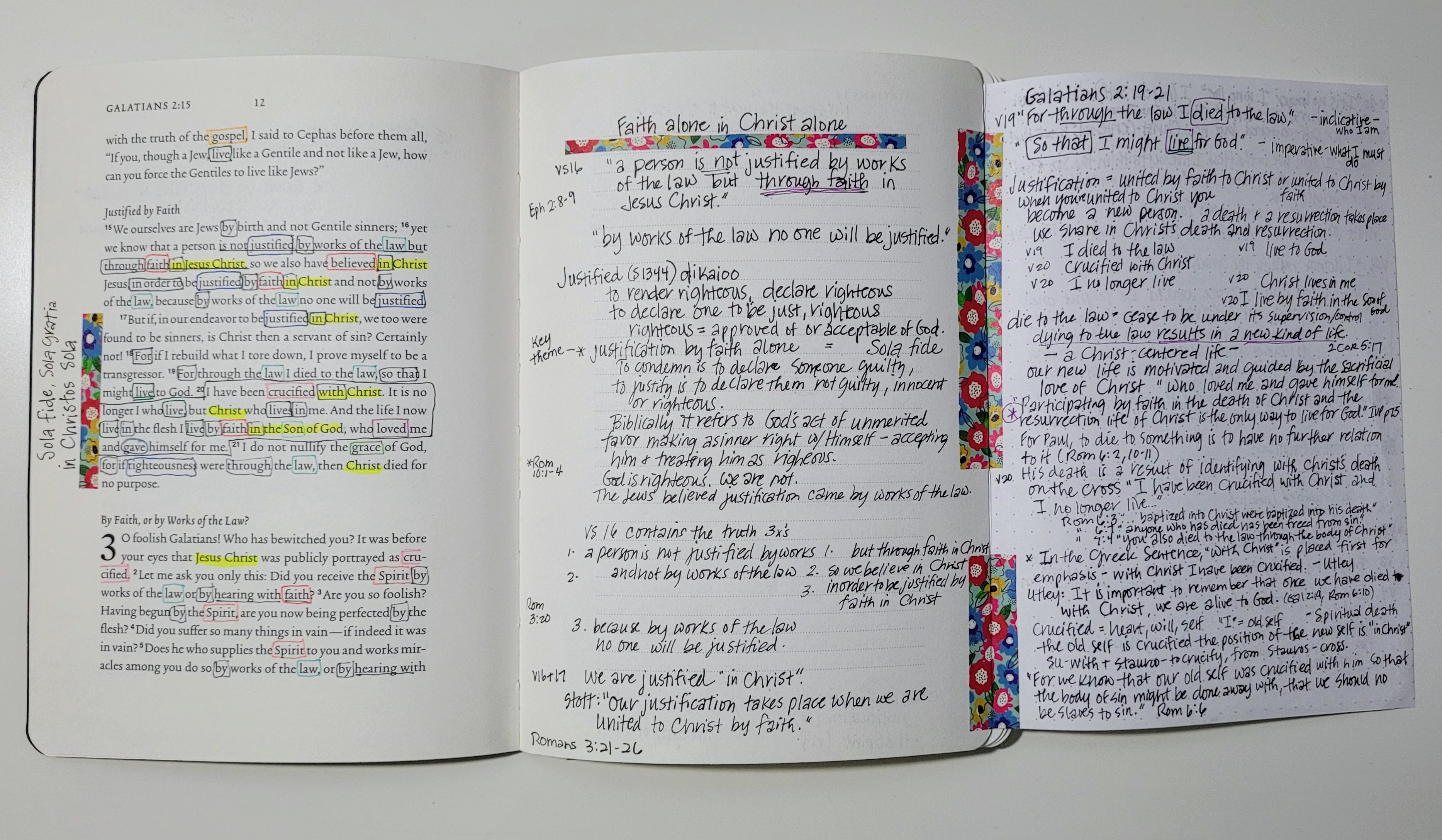
Sunday, September 11, 2022

Galatians Words ~ Word 6: Live


Galatians Words ~ Word 6: Live

“But if, in seeking to be justified in Christ, we Jews find ourselves also among the sinners, doesn’t that mean that Christ promotes sin? Absolutely not! If I rebuild what I destroyed, then I really would be a lawbreaker.

For through the law I died to the law so that I might live for God. I have been crucified with Christ and I no longer live, but Christ lives in me. The life I now live in the body, I live by faith in the Son of God, who loved me and gave himself for me.Galatians 2:17-20

The beginning verses of this passage can be confusing. To simplify it, Paul is responding to his critics who have misunderstood the gospel of justification They seem to think that if the law is eliminated then people will be encouraged to live any way they like, without moral standards. They think that because Paul and other Christ-followers are no longer observing the laws, such as observing the Sabbath, circumcision, not eating certain foods, they are living like sinners. Therefore, by their way of thinking, since they were justified by Christ, then Christ led them into sin. Paul addresses this same issue in Romans chapter 6.

Paul responds with “No way!”. His critics, the Judaizers, have failed to understand that union with Christ results in a changed life. He goes on to say in verse 18 that the law can no longer be used as a guide for judging the life of Christ-followers. Why? “For through the law I died to the law, so that I might live for God.” (2:19) Paul stopped trying to meet the requirements of the law, he ceased to be under its supervision, and instead turned to Christ for justification. He now lives for God. Justification through faith in Christ leads to a new life and a  transformed way of living.

Paul shares how this new life takes place in the next verse with the use of resurrection language - a death and a resurrection must take place. Let’s walk through verse 20 and break it down.

In the Greek, the sentence starts with “With Christ…”. Putting the emphasis of this sentence on Christ.

With Christ I have been crucified”. For Paul, to die to something is to have no further relationship with it, to no longer identify with it. I can’t help but look to Romans 6 to help us understand this verse. What has been crucified? Paul says in Romans 6:2 that “We died to sin; how can we live in it any longer?” So, our faith in Christ resulted in our sin and our old way of life being crucified with Christ on the cross. And notice that Paul says, “I have been crucified”, it was an act in the past that resulted in this crucifixion of sin. Let me be a bit of a grammar nerd here. ‘Have been crucified’ in the Greek is one word and it is a verb. All Greek verbs have a tense, a voice, and a mood which help us gain deeper understanding of what it means for us. This verb in verse 20, ‘have been crucified’ is perfect tense, its voice is passive, and its mood is indicative. So, what does that mean and why does it matter?

Perfect tense means that something happened in the past and is complete, once and for all. It does not need to be repeated, and the results of it continue. What happened in the past? Our crucifixion to sin and our old way of life.  Again, here is how Paul says this in Romans 6:6-7,” For we know that our old self was crucified with him so that the body ruled by sin might be done away with, that we should no longer be slaves to sin— because anyone who has died has been set free from sin.When did this crucifixion to sin take place? When we put our faith in Christ. (Galatians 2:16)

A passive verb means that someone, an outside agent, performed the resulting action. In this case, we did nothing to crucify ourselves and die to sin and our old way of life. In his death on the cross, Christ took on our sin and our old way of life was crucified with him.

An indicative mood means that the statement is a fact. When you put your faith in Christ, you ARE crucified with Him, you HAVE died to sin and your old way of life. There are no doubts about this fact. So, believe it and live it out.

Paul goes on in verse 20, “I no longer live”. Meaning my old self no longer lives. Just as Christ was raised from the dead to His resurrection life, I now live a new life. How? “Christ lives in me”. His Spirit resides in me and as Bruce Hurt says, “I am no longer self-centered but now Christ-centered.”.

Paul goes on. “The life I live in the body [the flesh, my time here on earth], I live by faith in [though union with] the Son of God, who loved me and gave himself for me.” (We’ll look at this last phrase of the verse in our next word!)

'Live' is key to this passage, appearing five times in verses 19 and 20, and putting an emphasis on the new life we have in Christ. The word 'live' is present tense meaning it is a continuous action – we continually, day-by-day, live by faith in the Son of God. Let me point to Romans 6 one more time to expand on what this means.

“Now if we died with Christ, we believe that we will also live with him. For we know that since Christ was raised from the dead, he cannot die again; death no longer has mastery over him. The death he died, he died to sin once for all; but the life he lives, he lives to God. In the same way, count yourselves dead to sin but alive to God in Christ Jesus.Romans 6:8-11

Because we have been crucified with Christ, we no longer live in our old ways, but rather we live for God by faith in Christ. Because He lives in us we are dead to sin and no longer a slave to it, therefore we are able to consider ourselves as we are – dead to sin and enabled to live the life of God through Christ.


Share how you respond in the Words Challenge Facebook group. You can also share on social media using #galatianswords.


Friday, September 9, 2022

Galatians Words ~ Word 5: In Christ


Galatians Words Word 5: In Christ

Today’s word is actually a phrase that has great significance in the New Testament and in the life of every Christ-follower. I have been tracking this phrase for several years as I study in the New Testament. Someday I hope to have a complete study of it.

Our faith, our identity, and our ability to live the life of a Christ-follower rests in the words ‘in Christ’. As we have seen in our previous words our salvation rests on the fact that through faith ‘in Christ’ we are justified; we are made righteous in the sight of God.

“…yet we know that a person is not justified by works of the law but through faith in Jesus Christ, so we also have believed in Christ Jesus, in order to be justified by faith in Christ and not by works of the law, because by works of the law no one will be justified.” Galatians 2:16

It may appear to be a simple phrase, but when we break it apart and understand its theological significance, we will gain a deeper understanding of this phrase, and I hope that you will then pause each time you see it in the New Testament as I do.

The word ‘in’ is an often-used preposition that we can tend to just skim over when we read, but biblically when it is connected with the words Christ, Jesus, Lord, or Him it holds great significance. ‘In’ refers to our state or position or standing.  That we are ‘in’ Christ means that our position, our identity, our very life is found within the sphere of Christ Jesus. ‘In Christ’ refers to our vital, personal union with Jesus. It’s meaning is parallel to John’s ‘abide in Him” in John 15. Commentator Kent Hughes says, “being in Christ indicates radical transformation”. As we have seen in Galatians 2:16, our relationship with God is based on our position ‘in Christ’. Our position in Christ is that we have put our faith in Him and are therefore justified with God by that faith.

‘In Christ’ is a favorite term of Paul’s, used 165 times in his epistles; this includes the synonymous phrase ‘in him’. When Paul uses this phrase, he is most often using it to refer to a Christ-follower, referring to his position and identity. In Galatians Paul uses this phrase 13 times. As noted, three of those times are in 2:16 alone.  Let’s look at some of the ways Paul uses this phrase in Galatians:

  • 2:4 Paul says that the Judaizers have “infiltrated our ranks to spy on the freedom we have in Christ”. Our union with Christ brings with it the benefit of certain freedoms.
  • 2:16 We have already looked at the fact that we are justified by faith in Christ. It also comes up in 2:17 and 2:20 as well.
  •  3:14 “In Christ Jesus the blessing of Abraham comes to the Gentiles, so that we might receive the promised Spirit through faith.” In Christ means we also have the Spirit in us.
  • 3:22 In Christ we receive the promises of God.
  • 3:26 In Christ we are sons (children) of God through our faith in Him.
  • 3:27 We are baptized into Christ and therefore are clothed with Him.
  •  3:28 The phrase ‘in Christ’ does not only impact us individually, but corporately as well. In Christ we belong to each other. We are “all one in Christ”. Not only that but we are all equal 'in Christ'.
  • 5:6 In Christ our faith expresses itself through love.

We will expand on many of the things expressed in the list above in our future words and gain a deeper understanding of them.

If you are ‘in Christ’, you are united to Christ and His Spirit lives in you. Your whole being and life is wrapped up ‘in Him’, and you are held secure and surrounded by Him. You have a vital, personal relationship with Him, and as Kent Hughes pointed out, being ‘in Christ’ means your life has been through a radical transformation! You have a new identity, a new purpose, a new calling, a new family, a new community, a new life!


For our next word we will look at one of the most known verses in the New Testamant. Read through 2:17-21 again to familarize yourself with this passage and prepare yourself for our next word, live.

Share how you respond in the Words Challenge Facebook group. You can also share on social media using #galatianswords.


Wednesday, September 7, 2022

Galatians Words ~ Word 4: Faith


Galatians Words ~ Word 4: Faith

Sola gratia, sola fide, solus Christus. Salvation is by grace alone though faith alone in Christ alone. This Latin phrase is the motto of the Protestant faith. The great reformer Martin Luther was known to add the word 'alone' after the words grace and faith in passages such as the one we are in today. 


[We] “know that a person is not justified by the works of the law, but by faith in Jesus Christ. So we, too, have put our faith in Christ Jesus that we may be justified by faith in Christ and not by the works of the law, because by the works of the law no one will be justified.” Galatians 2:16

Sola fide – through faith alone. Because the Galatian believers were being led to turn to believing that they had to add works of the law in order to be justified by God, Paul will reaffirm that justification is by faith in Christ alone. Add nothing else to it.

Three times in this one verse he uses the word faith – we are justified by faith in Jesus Christ, we have put our faith in Christ Jesus, that we may be justified by faith in Christ. Paul is very clear here. When you believe the gospel of grace you are believing in the faithfulness of God through Christ. John Stott says, when we put our faith in Christ Jesus it is “to put our whole trust and confidence in Jesus Christ to save us.” 

We put our faith in Christ, not just for salvation, but for all of our life. Paul will go on to say in this letter that:

  • ·       We “live by faith in the Son of God” 2:20
  • ·       By believing what we have heard about faith in Christ, “we receive the promised Spirit”. 3:2,5,14
  • ·       We who have faith “have are blessed along with Abraham”. 3:9,14
  • ·       Through faith we are “sons of God”. 3:26
  • ·       By faith we will receive the final not guilty verdict when we stand before God, “the righteousness for which we hope”. 5:5
  • ·       We become a part of “the household (or family) of faith”. 6:10

All this is ours through faith alone in Christ alone.

In the book of Romans Paul reminded us that, “Faith comes from hearing the message (gospel, good news), and the message is heard through the word of Christ”. Romans 10:17. In Galatians Paul reminds them to hold onto that message they heard through faith when Paul shared with them the word of Christ – Christ’s teachings and example. Hold onto that message of faith and don’t let anything sway you away from it or try to get you to add anything to it, for you have been saved through faith in Christ by grace alone.

We are called to live by faith, and although at times we may doubt that we have enough faith, remember it not about how big our faith is, but about how big God is. We have placed our faith in Him and in His faithfulness. That is where the faith we are called to live by comes from. We did not have to do anything to earn it and we don’t have to work hard to muster it up, we must simply trust God and rely on His faithfulness through the power of the Holy Spirit within us. 


We will continue in this same passage for our next word on Friday.

Share how you respond in the Word Challenge Facebook Group. You can also share on social media using #galatianswords.

Monday, September 5, 2022

Galatians Words ~ Word 3: Justified


Galatians Words ~ Word 3: Justified

We have seen so far that Paul is passionate about the gospel of grace. That gospel message is salvation by grace alone through faith alone in Christ alone. Today’s word, justified appears first in 2:15-21, as do our next four words. So, we will be camping in this passage for a while.

Before we dive into our word let’s briefly fill in what has taken place between the beginning of chapter one, where we found our first two words in 1:6-7, and the passage we will look at today. That way we will have a full picture of Galatians as we go.

In 1:11-24, Paul clearly expresses his apostolic calling from God and the validity of his gospel message. Remember the Judaizers are trying to subvert both Paul’s authority and his teaching. So, he reminds them that the gospel he preaches was “received through a revelation of Jesus Christ” (1:12). He also reminds them of his former way of life as a Pharisee (1:13-14), but through a divine intervention of grace God revealed the Son to him, transformed his life, and called him to preach the gospel to the Gentile (1:15-24).  He then shares about his earlier journeys and about how Titus, a Gentile, was not forced to be circumcised, but then some ‘false brothers’ got upset about their freedom in Christ – i.e., they were not observing Jewish customs and laws – but Paul did not give in and was commissioned as a preacher to the Gentiles (2:1-10). Finally, in 2:11-14, Paul shares about a disagreement he had with the way Peter was openly eating with Gentiles (this was against Jewish customs) in Antioch until some Jews visited and Peter separated himself from the Gentiles to save face with the Jews. Paul called Peter out in front of everyone for his hypocrisy. The New Living Translation gives us an easy to understand version of what Paul says to Peter:

“When I saw that they were not following the truth of the gospel message, I said to Peter in front of all the others, “Since you, a Jew by birth, have discarded the Jewish laws and are living like a Gentile, why are you now trying to make these Gentiles follow the Jewish traditions?Galatians 2:14

So, with this background Paul will now begin to talk about justification in 2:15-21.


If grace is the heart of Paul’s gospel, then justification is the backbone.

A simple definition of justification is that one is made righteous and accepted by God. When one is made righteous in the eyes of God, they are declared not guilty of their sin. God is a holy, just, and righteous God, and He desires that His people will pattern their lives after Him, therefore they will live righteous lives. But throughout the history of the Old Testament God’s people struggled to live as God called them to. By the time Jesus was born the Pharisees had developed a system of laws (over 600 of them!), that required one to live by them to be declared a righteous person. But the burden of trying to follow so many laws to earn God’s favor was too much for the people to carry. So, imagine the relief that people felt when Paul began to share the good news that they could be justified with God through faith in Jesus Christ alone.

In our passage Paul uses the word 'justified', or its synonym 'righteousness', five times. When we see a word used so many times in a small passage, we know that the author is trying to get a point across. This is one of the values of marking repeated words in Bible study. When they are marked, we are more likely to notice a pattern that leads to revealing a significant biblical truth. Let’s see what Paul tells us with his repeated use of 'justified'.

In 2:16, Paul says that “a person is not justified by works of the law but through faith in Christ”. This is the backbone of the Christian faith. We do not need to work hard to earn God’s favor. We don’t have to try hard to follow a bunch of laws to prove that we are good enough for God. God, in His mercy, sent His Son into the world and then gave His Son up as a sacrifice – an atonement for our sins – and through faith in the risen work of Christ on the cross we are justified before God. Jesus paid all our debts! And God now calls those who believe in Jesus Christ debt free from the penalty of sin – we are now justified before God. Paul continues in verse 16 that those who know this to be true,

“…have believed in Christ Jesus in order to be justified by faith in Christ and not by works of the law, because by works of the law no one will be justified.”

This is the gospel: We believe in Christ Jesus. Why? In order to be justified before God by faith in Christ. Why not in works of the law? Because by works of the law no one will be justified. It just doesn’t work. We will see in chapter 3 what the purpose of the law was and why it did not serve to justify people.

Justification or justified are not words that are used often in our modern times. But as Christ-followers it is a term we should become very familiar with, for in understanding this word and sharing it’s message of hope and freedom, we can help others become justified with God as well.


We will continue on in this passage Wednesday when we look at the word faith.

Share how you respond in the Words Challenge Facebook group. You can also share on social media using #galatianswords.


Saturday, September 3, 2022

Galatians Words ~ Word 2: Gospel


Galatians Words ~ Word 2: Gospel

Our first word showed us that grace is Paul’s focus in the book of Galatians. Why? Because grace is at the heart of the gospel.


Here is Paul’s gospel message: Jesus Christ “gave himself for our sins to rescue [or deliver] us from this present evil age” (1:3). Paul tells us that Jesus did this “according to the will of God the Father” (1:3). We are “justified [made righteous, right with God] through faith in Christ alone” Not by rules or the law or anything we could do. Paul’s gospel is that salvation is by grace alone through faith alone in Jesus Christ alone.

In Galatians 1:6-7, Paul shares with us the problem the Galatians churches were facing and the reason why he wrote this letter.

“I am astonished that you are so quickly deserting the one who called you to live in the grace of Christ and are turning to a different gospel— which is really no gospel at all. Evidently some people are throwing you into confusion and are trying to pervert the gospel of Christ.

Let’s look a little deeper at what this problem consisted of. We will, of course, come across it again in more detail as we go through the book and our list of words.

I’m struck first by Paul saying the Galatians are ‘turning’ to a different gospel. The gospel Paul taught them is fully dependent on the grace of God. Paul is passionate about grace, and it is because of his own dramatic conversion from being a Jewish Pharisee to being a fully devoted follower of Christ. In Paul’s previous life he was dogmatic about observing the many laws of the Jewish code and traditions. So dogmatic that he persecuted those who claimed faith in Christ. But when he himself met Christ face-to-face and he experienced the grace of God through Christ, Paul completely turned from his old way of life to embrace fully the new creation he is in Christ.

Last Sunday we had a baptism service at our church. 3 adults and 10 kids publicly proclaimed their faith in Christ in the baptismal pool. As a part of our baptism practice, each person physically is turned around as they affirm that they have turned from their own way and from sin and have turned to God’s way and a life devoted to Christ. This is a physical, visual way of expressing our faith in Christ.  To Paul, when the Galatians believe what these false teachers are telling them, it is very much like turning away form Christ and the gospel of grace.

These false teachers are believed to be Jews who most likely traveled from Jerusalem. They are often known as Judaizers, because they tried to impose Jewish law and practices on the Gentile believers. They were seeking to subvert Paul’s authority and his teaching.

Their ‘different gospel’ was a mix of salvation by faith in Christ and by observance of Jewish ceremonies and practices. In other words, grace plus works in order to be justified before God. They taught that the Gentile believers must become Jewish (undergo circumcision) and practice their ceremonies (Sabbath and other holy days) and observe the rules of the law to fully follow God. The Galatian believers were Greek Gentiles who would not have known much about the Jewish laws and traditions, and thus were easily swayed by these Judaizers who sounded spiritual and knowledgeable. So, Paul writes to the Galatian churches to get them back on track with the gospel of grace alone. This will all play out throughout the letter. This problem in the Galatian churches with the Judaizers also will lead to the Jerusalem Council, which you can read about in Acts 15. The Jerusalem Council will settle for all the churches that salvation is by grace alone and Gentile believers do not need to be circumcised when they follow Christ.

Because of Paul’s own transformation and his passion for the gospel of grace, he is passionate in this letter to the Galatians, sharing his despair and frustration intensely with them. Yet also reminding them of how they came to believe in Jesus Christ as a result of the gospel of Grace. The gospel is the good news for all, and Paul calls the Judaizers message “a different gospel – which is really no gospel at all” – it has no good news in it! And this is the danger then and now when we try to add anything to the gospel of grace: It holds no good news, it sets aside the grace of God and makes a mockery of Christ’s sacrifice on the cross (2:21), and it results in falling away from grace and alienating Christ (5:4). The gospel of grace helps us have a correct view of ourselves and of God. Justification is fully the grace of God. We belong to God’s family because of what Jesus did for us, not because of anything we do.

If you add anything to the gospel, you lose the gospel. The gospel is Jesus Christ alone – solus Christus.

If you would like to spend some time preparing for our next word, justified, which will be presented on Monday. I suggest reading Chapter 2. Our next five words actually come up in chapter two. Color code those words and circle them in your Scripture Journal or on the copy of Galatians you made. We are going to dive into  lots of theology with these words found in chapter 2, especially in 2:15-21. We are going to slowly go through this passage so that we fully understand Paul's use of the next five words.

If you really want to dig in, here's an idea: Using Galatians 2:15-21, try 'walking' through the passage. I have a quick tutorial explaining what that means here. This is a great passage, but Paul has filled it with so much deep truth that it can be difficult to figure out exactly what he is saying. See if following the steps to 'walk' through the passage helps you understand it better.


Share how you respond in the Words Challenge Facebook group. You can also share on social media using #galatianswords.