Tuesday, August 14, 2018

Colossians Words Day 14: Death


Day 14 ~ Death

Our word today and our word tomorrow, death and life, go together and are often used in the New Testament to indicate our former life and our new life. Paul, in particular, likes to use the death/life contrast to remind Christ followers of who they once were and call them to live out of who they now are. In Colossians this death/life contrast is seen throughout chapters 2 and 3 (2:9-3:10). Paul will use a number of terms and situations for this death/life contrast to further support his main emphasis: Christ is all (3:11). It is a little difficult to separate all that is connected to these two words, so we will just divide this large passage in two. We will go through 2:9-23 today as it pertains to the death/life contrast, and go through 3:1-10 tomorrow. 

"For in Christ all the fullness of the Deity lives in bodily form, and in Christ you have been brought to fullness. He is the head over every power and authority. In him you were also circumcised with a circumcision not performed by human hands. Your whole self ruled by the flesh was put off when you were circumcised by Christ, having been buried with him in baptism, in which you were also raised with him through your faith in the working of God, who raised him from the dead.
When you were dead in your sins and in the uncircumcision of your flesh, God made you alive with Christ. He forgave us all our sins, having canceled the charge of our legal indebtedness, which stood against us and condemned us; he has taken it away, nailing it to the cross. And having disarmed the powers and authorities, he made a public spectacle of them, triumphing over them by the cross." Colossians 2:9-15
Paul begins by reminding them of the incarnation - Jesus Christ was both God (Deity) and man (bodily form) - He is the fullness of God and that fullness now dwells in His people as well. Why does Paul feel the need to focus on Christ's dual nature as God and man? He was refuting the false teachers who are believed to have focused on Jesus as either one who came to earth in angelic form and thus not human, or that Jesus was merely a man who the "Christ spirit" came upon for a short time. Jesus Christ was fully man and fully God. Why does it matter to us? Because we are complete in Him. His Spirit lives in us. We are His spiritually and materially. Our existence in Christ is both physical and spiritual and Paul will go on in this passage using circumcision and baptism to illustrate this.
Circumcision was the symbol used by Jewish people as an outward sign of their covenant relationship with God. Paul came under attack by Jewish Christians who felt that the Gentiles who had converted to faith in Christ must also be converted to Judaism and thus be circumcised. At the Jerusalem council (Acts 15:1-29) it was argued that the Holy Spirit was now the sign of the new covenant with God and that Jews and Gentiles alike, through faith in Christ, are now the people of God. No other requirements are necessary. However, in the church at Colosse this seemed to be one of the issues raised in the false teaching. Paul now uses this issue to teach the Colossians. While I would love to dig deeper into this, it would take too much time, and space. Read the above mentioned passage in Acts, plus Romans 6 and Ephesians 2 to gain a fuller understanding of this issue and for a great Bible study!
In verses 11 and 12, Paul says that in Christ we have already been circumcised - that is, through the regenerating power of the Spirit of God (Read Romans 2:29) in us, the sinful nature has been put off or removed. He then points to baptism as the outward sign of the new covenant between God and His people. The "circumcision done by Christ" took place when we came to faith in Christ, we were "buried with Him in baptism" and then "raised with him" to new life. (See also Romans 6:3-4.) Paul goes on to point out in verse 13 that before this you were "dead in your sins", our sinful nature was uncircumcised, it had not yet been removed.


The incarnation of Jesus Christ is significant to the new covenant because it is in Christ's death and resurrection that we have new life through His Spirit. It is through His death and resurrection and indwelling Spirit that we are "in Christ". Our baptism shows the world that our old self (Colossians 3:9) and our sinful nature have been buried with Christ, put to death with Him. This is represented when we go down into the water. We are then raised with Christ to new life, we are made "alive with Christ" (2:13), symbolized by our coming up out of the water.  Faith in Christ is the only thing required for this new life. No added laws or traditions, such as circumcision. Simply put we are made alive with Christ because "he forgave us all our sins" (2:13-15). Paul will go on in Colossians 2:16-23 to point out that the various rules, laws and traditions being falsely preached as necessary to be included as members of God's people, are merely "a shadow of the things that were to come" (2:17). Meaning that before Christ they practiced these things symbolically in anticipation of and preparation for the Christ's arrival. It is now no longer necessary to practice them because "the reality is found in Christ" (2:17). "Since you died with Christ" you no longer need to practice the practices of the world or religious regulations (2:20-23).


We will go on tomorrow to look at the significance of being "made alive with Christ". Then the next day we will dig into Paul's repeated use of "in Christ" and "with Christ". This letter is such a vital means by which we can become secure and firm in our understanding and belief that faith in Christ alone is all we need for peace with God. His life, death and resurrection were the Father's great sacrifice of love on our behalf. The Father's great desire is that we know Him and become His people.
"Therefore, remember that formerly you who are Gentiles by birth and called “uncircumcised” by those who call themselves “the circumcision” (which is done in the body by human hands)— remember that at that time you were separate from Christ, excluded from citizenship in Israel and foreigners to the covenants of the promise, without hope and without God in the world. But now in Christ Jesus you who once were far away have been brought near by the blood of Christ." Ephesians 2:11-13
"But you are a chosen people, a royal priesthood, a holy nation, God’s special possession, that you may declare the praises of him who called you out of darkness into his wonderful light. Once you were not a people, but now you are the people of God; once you had not received mercy, but now you have received mercy." 1 Peter 2:9-10
If you are behind or just joining in, you can find a list with links to the previous words here.

Please share your creative responses to today's word and Bible verses in the Words Facebook group or on Instagram using #colossianswords.

#foundonbrighton #everydayjournals2018

Monday, August 13, 2018

Colossians Words Day 13: Heart


Day 13 ~ Heart


In the passage we looked at yesterday (Colossians 1:24-2:5) Paul said that he serves the Colossians by encouraging or strengthening their hearts in order that they may have complete understanding to know the mystery of God: Christ. (2:2) 

When we think of the word heart in our day and age, we tend to think mainly of emotions. In Greek and Hebrew thought, however, the word heart encompassed so much more. To them the heart was the center of  life, the whole inner person. Their understanding of heart encompasses the emotions, intellect, will, character and soul. Scripture recognizes that it is with the heart that man makes decisions. The heart directs our thoughts. It is with this in mind that Paul calls us to "Let the peace of Christ rule (dwell) in your hearts..." (Colossians 3:15) and to serve and worship "with gratitude in your hearts to God" (3:16). If the heart is the center of life, then this verse could  say that we are to let the peace of Christ rule at the center of our being, the center of who we are.

When we are steeped in God's Word we gain the knowledge of His will and His ways. When God's peace dwells in us it is an indicator that we abide in Christ. As a result our thoughts and our actions will flow out of what is in our hearts. An attitude of peace and gratitude in our hearts will guide our thoughts and actions to the good pleasure of the Father.


If you are behind or just joining in, you can find a list with links to the previous words here.
Please share your creative responses to today's word and Bible verses in the Words Facebook group or on Instagram using #colossianswords.

#foundonbrighton #everydayjournals2018

Sunday, August 12, 2018

Colossians Words Day 12: Mystery


Day 12 ~ Mystery

Our words for the first half of the challenge have led us through the first chapter of Paul's letter to the Colossians, with a few detours to other portions of the book as we have traced out their usage. In the first section of the letter (1:3-1:23) Paul has laid out the gospel: salvation comes through faith in Christ alone. He has done so by exalting the supremacy of Christ. Paul now shifts in his letter to share his personal mission commissioned by God.

"Now I rejoice in what I am suffering for you, and I fill up in my flesh what is still lacking in regard to Christ’s afflictions, for the sake of his body, which is the church. I have become its servant by the commission God gave me to present to you the word of God in its fullness— the mystery that has been kept hidden for ages and generations, but is now disclosed to the Lord’s people. To them God has chosen to make known among the Gentiles the glorious riches of this mystery, which is Christ in you, the hope of glory.
He is the one we proclaim, admonishing and teaching everyone with all wisdom, so that we may present everyone fully mature in Christ. To this end I strenuously contend with all the energy Christ so powerfully works in me.
I want you to know how hard I am contending for you and for those at Laodicea, and for all who have not met me personally. My goal is that they may be encouraged in heart and united in love, so that they may have the full riches of complete understanding, in order that they may know the mystery of God, namely, Christ, in whom are hidden all the treasures of wisdom and knowledge. I tell you this so that no one may deceive you by fine-sounding arguments. For though I am absent from you in body, I am present with you in spirit and delight to see how disciplined you are and how firm your faith in Christ is." Colossians 1:24-2:5
So, how was Paul commissioned by God? For the answer to this we need to look at the book of Acts. Acts 9:1-31 describes Paul's journey along the road to Damascus. Paul had been a zealous member of the Pharisees, persecuting Jewish people who had become followers of Christ. On his journey to Damascus Paul has an encounter with Christ which will change the course of his life. It is in this encounter that the Lord speaks to a man named Ananias, revealing His call on Paul's life:
"The Lord said to Ananias, “Go! This man is my chosen instrument to proclaim my name to the Gentiles and their kings and to the people of Israel." Acts 9:15
The rest of the story in Acts tells us that Paul was immediately baptized, began preaching about salvation through Christ, and the church grew as a result.

What does God's commission of Paul require of Him? Paul says that in order to carry out this commission he must become a servant of Christ's body here on earth, the church. And in doing so, he like Christ, will suffer. In fact, Paul writes this letter to the Colossians while imprisoned in Rome for preaching Christ as king, which broke the Roman laws that they would serve no other king but the Roman king. Verse 24 says, "I fill up in my flesh what is still lacking in regard to Christ's afflictions". This is a very difficult verse to understand and commentators have varying views in explaining it. I am not even going to try and figure out its meaning. I feel Pastor Gregory Brown, Bible.org, has made the most sense of it in simple terms:
"He is not talking about Christ's atoning work on the cross. Christ's work was perfect and complete. The writer of Hebrews said this: "Day after day every priest stands and performs his religious duties; again and again he offers the same sacrifices, which can never take away sins. But when this priest (Jesus) had offered for all time one sacrifice for sins, he sat down at the right hand of God." Hebrews 10:11-12. Paul is referring to suffering the afflictions Christ would suffer if he was still on the earth. Christ said this to his disciples in John 15:20: "No servant is greater than his master. If they persecuted me, they will persecute you also..." Christians suffer the persecution that their master would if he was still on the earth. The more our life models His, the more we will receive the same animosity he did." 

What is God's commission of Paul? Verse 25 tells us: "to present the word of God in its fullness". This is the mystery that Paul refers to. So what is the full word of God? It's twofold. First, the mystery is that what was hidden for ages and generations has now been disclosed to the Lord's people: His plan of salvation is not for the Jews alone. It includes the Gentiles. When the resurrected Jesus appeared to his disciples, he gave them His Great Commission:
"All authority in heaven and on earth has been given to me. Therefore go and make disciples of all nations..." Matthew 28:18-19. In commissioning Paul to proclaim Christ's name to the Gentiles, the work of the Great Commission begins. Jews and Gentiles alike become God's holy people. Paul put it like this to the Ephesians:
"Surely you have heard about the administration of God’s grace that was given to me for you, that is, the mystery made known to me by revelation, as I have already written briefly. In reading this, then, you will be able to understand my insight into the mystery of Christ, which was not made known to people in other generations as it has now been revealed by the Spirit to God’s holy apostles and prophets. This mystery is that through the gospel the Gentiles are heirs together with Israel, members together of one body, and sharers together in the promise in Christ Jesus." Ephesians 3:2-6


The second part to this mystery is "Christ in you , the hope of glory." (1:27). Now, through Christ's death and resurrection and the gift of God's Holy Spirit, Christ dwells in His people. Although God's plan was hidden in the Scriptures, it was not fully revealed until the coming of Christ. "..That they may know the mystery of God, namely Christ, in whom are hidden all the treasures of wisdom and knowledge." Colossians 2:3.

We continue Paul's commission today as well. Paul says in his second letter to the Corinthians that the minds of unbelievers are blinded to the gospel of the glory of Christ.
"Therefore, since through God’s mercy we have this ministry, we do not lose heart. Rather, we have renounced secret and shameful ways; we do not use deception, nor do we distort the word of God. On the contrary, by setting forth the truth plainly we commend ourselves to everyone’s conscience in the sight of God. And even if our gospel is veiled, it is veiled to those who are perishing. The god of this age has blinded the minds of unbelievers, so that they cannot see the light of the gospel that displays the glory of Christ, who is the image of God. For what we preach is not ourselves, but Jesus Christ as Lord, and ourselves as your servants for Jesus’ sake. For God, who said, “Let light shine out of darkness,” made his light shine in our hearts to give us the light of the knowledge of God’s glory displayed in the face of Christ." 2 Corinthians 4:1-6. Paul will go on to say in the next chapter that we - the followers of Christ - have been given the same ministry of reconciliation that he received. "And he has committed to us the message of reconciliation. We are therefore Christ’s ambassadors, as though God were making his appeal through us. We implore you on Christ’s behalf: Be reconciled to God." 2 Corinthians 5:19-20. We are called to share our story, and the life of Christ in us, who is the hope of glory for all mankind. 


If you are behind or just joining in, you can find a list with links to the previous words here.

Please share your creative responses to today's word and Bible verses in the Words Facebook group or on Instagram using #colossianswords.

#foundonbrighton #everydayjournals2018


Saturday, August 11, 2018

Colossians Words Day 11: Holy


Day 11 ~ Holy


Today's word, holy, flows out of yesterday's word, reconcile.  We will begin in the same verse we left off in yesterday:
"But now he has reconciled you by Christ’s physical body through death to present you holy in his sight, without blemish and free from accusation—" Colossians 1:22

The ultimate purpose for God reconciling us is that we may become His holy people.


The Greek word for holy is hagios (40) and is translated in the book of Colossians as saints (1:2, 4, 12, 26), as well as holy (1:22 & 3:12). Holy means to be set apart for or dedicated to God's service. The word used by the New Testament writers has the same sense as the Hebrew word kadosh, which relates to God's presence in something, some place or someone. For Paul to call the Colossians "saints" in this letter has the feel of calling them into living out who they already are - those who have been made holy through Christ.

As Christ followers this is who we are, it is our position before God -  we are saints, we are holy. We are holy because of what God has done for us through Christ, not because of anything we have done.  We don't earn holiness -  we grow in it as we walk with Christ -  but we can't earn it. Our position as holy is ours because of what Christ has done for us, in our place. Christ is holy; Christ in us is what makes us holy.

To be holy, Paul says, is to be without blemish. This is language that reminds Paul's readers of the Old Testament sacrificial offering. 
"They are to present their offerings to the Lord: a year-old male lamb without defect for a burnt offering..." Numbers 6:14.
Jesus, is now that sacrificial lamb, who was without blemish - free from sin.
"John saw Jesus coming toward him and said, “Look, the Lamb of God, who takes away the sin of the world!" John 1:29
"For you know that it was not with perishable things such as silver or gold that you were redeemed from the empty way of life handed down to you from your ancestors, but with the precious blood of Christ, a lamb without blemish or defect." 1 Peter 1:18-19
We stand in God's sight, unblemished - without the stain of sin - because of the work of Christ. 

We are also "free from accusation". We cannot be condemned to a guilty sentence because of our sin.
"Therefore, there is now no condemnation for those who are in Christ Jesus, because through Christ Jesus the law of the Spirit who gives life has set you free from the law of sin and death. For what the law was powerless to do because it was weakened by the flesh, God did by sending his own Son in the likeness of sinful flesh to be a sin offering.And so he condemned sin in the flesh, in order that the righteous requirement of the law might be fully met in us, who do not live according to the flesh but according to the Spirit." Romans 8:1-4.

In the Bible holiness has a past, present and future sense. Through faith in Christ we are holy because of what Christ did for. We rest in that accomplished work of Christ as we grow in holiness in this life, until that day when we will stand before Him completely holy.
"But in keeping with his promise we are looking forward to a new heaven and a new earth, where righteousness dwells.
So then, dear friends, since you are looking forward to this, make every effort to be found spotless, blameless (holy) and at peace with him." 2 Peter 3:13-14.
"May he strengthen your hearts so that you will be blameless and holy in the presence of our God and Father when our Lord Jesus comes with all his holy ones." 1 Thessalonians 3:13.
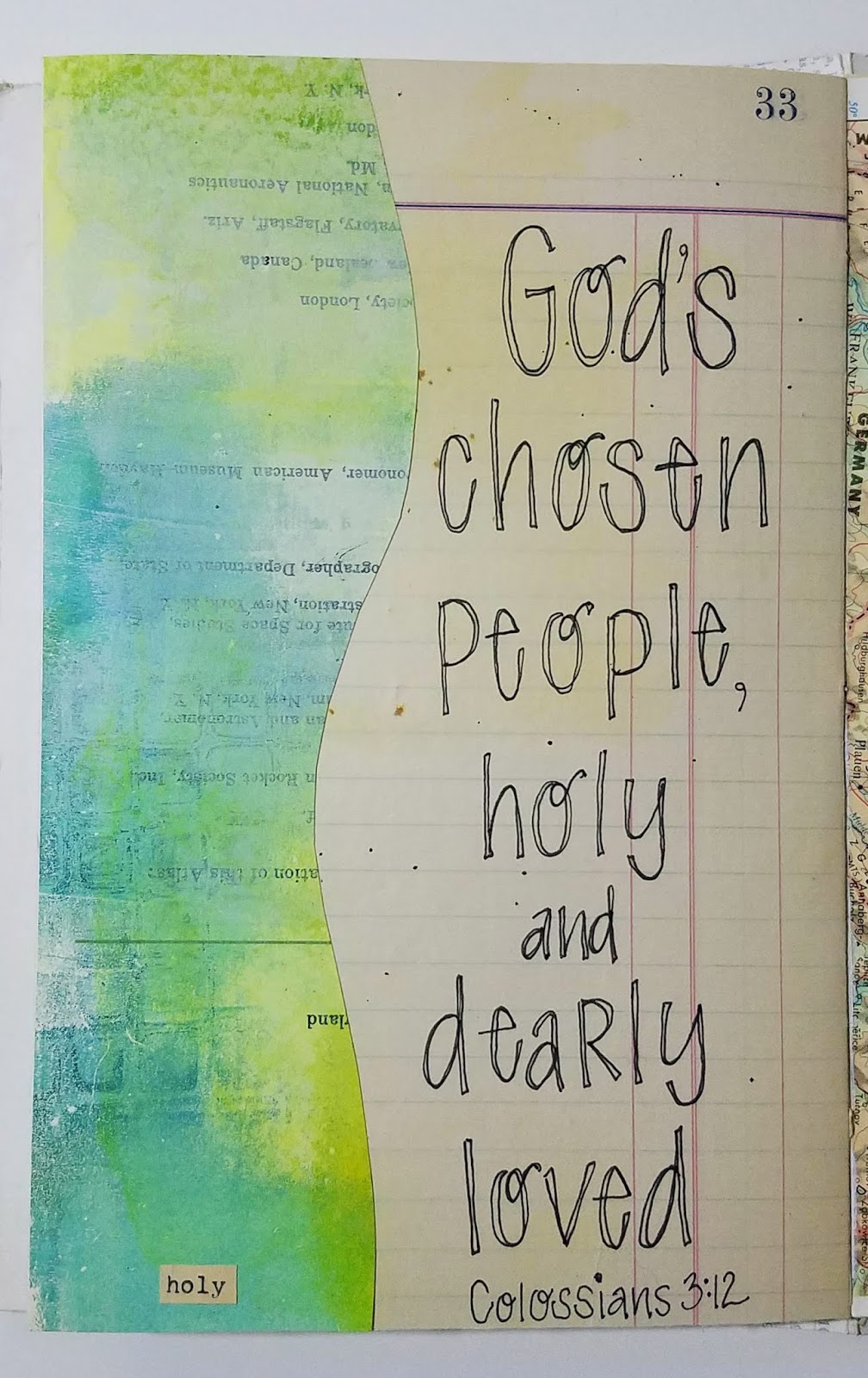
Later in the book Paul will implore the Colossians to live a godly life because they are "God's chosen people, holy and dearly loved" Colossians 3:12
Because we are God's holypeople, we are called to holy living.
"But just as he who called you is holy, so be holy in all you do; for it is written: “Be holy, because I am holy.” 1 Peter 1:19

Please share your creative responses to today's word and Bible verses in the Words Facebook group or on Instagram using #colossianswords.
#foundonbrighton #everydayjournals2018


Friday, August 10, 2018

Colossians Words Day 10: Reconcile


Day 10 ~ Reconcile


In studying a book of the Bible some words are significant because they are used so often, such as "all", which was used 30 times in Colossians. Its repeated use draws us into the heart of the  message Paul is preaching throughout this book - Christ is all in all. Other words are significant in a book simply because of their theological meaning. This is the case with our word today: Reconcile. The message of reconciliation is at the heart of the gospel. Reconcile is only used twice in the book of Colossians. Both times are in one passage toward the end of chapter 1. We will dig into this passage today to gain a full understanding of the reconciliation Christ brings us.

"For God was pleased to have all his fullness dwell in him, and through him to reconcile to himself all things, whether things on earth or things in heaven, by making peace through his blood, shed on the cross.
Once you were alienated from God and were enemies in your minds because of your evil behavior. But now he has reconciled you by Christ’s physical body through death to present you holy in his sight, without blemish and free from accusation— if you continue in your faith, established and firm, and do not move from the hope held out in the gospel. This is the gospel that you heard and that has been proclaimed to every creature under heaven, and of which I, Paul, have become a servant." Colossians 1:19-23
The word reconcile means to bring back a former state of harmony; to change from hostility to peace, especially between persons; to restore to a right relationship. Paul says that it is through Christ that all things are reconciled to God. 
So, let's break down this passage to see what this means:
First, it is through Christ that God chose to reconcile all things to Himself. Jesus Christ is the only way to peace with God. This message is seen throughout the Bible. Jesus himself said, "I am the way and the truth and the life. No one comes to the Father except through me." John 14:6. This message is explained fully earlier in the Gospel of John. "For God so loved the world that he gave his one and only Son, that whoever believes in him shall not perish but have eternal life. For God did not send his Son into the world to condemn the world, but to save the world through him. Whoever believes in him is not condemned, but whoever does not believe stands condemned already because they have not believed in the name of God’s one and only Son." John 3:16-18. Paul states is this way in his letter to Timothy, "For there is one God and one mediator between God and mankind, the man Christ Jesus, who gave himself as a ransom for all people." 1 Timothy 2:5-6. And again in his letter to the Romans, "Therefore, since we have been justified through faith, we have peace with God through our Lord Jesus Christ, through whom we have gained access by faith into this grace in which we now stand." Romans 5:1-2.  
How does Jesus Christ reconcile all things to God? Paul explains this in the second half of 1:20: By making peace (this is reconciliation) through His blood which was shed on the cross. In Ephesians he states it this way, "But now in Christ Jesus you who once were far away have been brought near by the blood of Christ." Ephesians 2:13. He explains this further in Romans. "But now apart from the law the righteousness of God has been made known, to which the Law and the Prophets testify. This righteousness is given through faith in Jesus Christ to all who believe. There is no difference between Jew and Gentile, for all have sinned and fall short of the glory of God, and all are justified freely by his grace through the redemption that came by Christ Jesus. God presented Christ as a sacrifice of atonement, through the shedding of his blood—to be received by faith." Romans 3:21-25. Jesus Christ became the sacrifice that atoned (pardoned, amended) for our sins. In the Old Testament people had to be made right with God by sacrificing the blood of animals, but now through the blood of Jesus, that God sacrificed, we are made right with God.
Why do we need to be reconciled (made right) with God? Paul goes on to explain this in verses 21-22 of our passage. "Once you were alienated from God and were enemies in your minds because of your evil behavior." (1:21).  What alienates us or separates us (Ephesians 2:12) from God is sin. God's desire is that we return to a state of harmony, of peace, with Him. In the beginning God created a world that was fully at peace with Him (Genesis 1-2). But then sin entered the garden and Adam and Eve turned away from and hid from God. Because of their sin all of mankind suffered and became alienated from God. 
"Consequently, just as one trespass resulted in condemnation for all people, so also one righteous act resulted in justification and life for all people. For just as through the disobedience of the one man the many were made sinners, so also through the obedience of the one man the many will be made righteous." Romans 5:18-19
Paul again explains how we are reconciled to God in verse 22. "But now he has reconciled you by Christ’s physical body through death to present you holy in his sight, without blemish and free from accusation." (1:22). This once/now contrast serves as a reminder to the Colossians of their position before and after they came to faith in Christ through hearing the gospel message (1:5, 1:13, 1:23).
Paul continues in verse 22 to say  that God reconciles us through Christ in order to "present you holy in his sight, without blemish and free from accusation". Paul says it like this in 2 Corinthians 5:21, "God made him who had no sin to be sin for us, so that in him we might become the righteousness of God."  That we become the righteousness of God means that we are now holy in the presence of God. The message of reconciliation is at the heart of the Gospel - it is the Good News!